Integrating Functional Training and Mobility Work into Hypertrophy
Training Strategies
Summary
Traditional bodybuilding has long emphasized isolated, rigid movements to maximize muscle growth. The common belief is that hypertrophy—defined by increased muscle size—requires machines, stable positions, and linear loading. Meanwhile, functional training—focused on movement quality, joint integrity, and real-world performance—is often viewed as incompatible with muscle development.
However, this dichotomy is false.
Indeed, some methods marketed as “functional training”—like squatting on a BOSU ball to improve stability—can be counterproductive. On unstable surfaces, the central nervous system naturally downregulates force output to protect the body, reducing the effectiveness of strength or hypertrophy work (Behm & Anderson, 2006). But when functional training is intelligently designed, rooted in biomechanics and structured loading, it becomes a potent tool for performance, mobility and muscle growth.
Recent studies in exercise science have shown that the mechanisms that drive hypertrophy, such as eccentric loading, time under tension, and mechanical stress, are not only compatible with functional training but enhanced by it (Schoenfeld, 2010; Wernbom et al., 2007). When executed correctly, functional movements emphasizing joint positioning, mobility, and stability can produce significant muscular gains while improving performance, posture, and injury resilience.
This write-up explores how training for joint function, rather than isolated muscle contraction, can create synergy between hypertrophy and functional performance. We’ll examine how eccentric control, full range of motion, and smart exercise pairing (such as supersets) can maximize both muscle development and movement quality.
Thinking in terms of joints rather than muscles
To integrate hypertrophy with functional performance, it's essential to train muscles not in isolation, but in relation to the joints they influence. Most muscles span across at least one joint, and many—like the hamstrings, rectus femoris, or latissimus dorsi—cross two. This means that the position and movement of both joints significantly affect the length-tension relationship, recruitment pattern, and growth potential of the muscle.
Stimulating a muscle at both ends—i.e., across both joints it crosses—offers several benefits:
Greater hypertrophy potential: Research has shown that training through long muscle lengths, particularly under eccentric loading, results in superior hypertrophic outcomes (Maeo et al., 2021; Schoenfeld, 2010). This is especially effective when both ends of a muscle are actively loaded, which increases mechanical tension and motor unit recruitment.
Improved muscular symmetry and aesthetics: When a muscle is only trained at one joint, certain regions may become overdeveloped while others remain understimulated. For example, over-relying on knee-dominant quad exercises may neglect the rectus femoris, resulting in incomplete quad development. Addressing both joint actions ensures balanced growth across the muscle belly.
Enhanced performance and joint control: Functionally, training both ends of a muscle supports better coordination across movement chains. When a muscle is strong throughout its entire range and across all relevant joint actions, it's more capable of stabilizing dynamic movements and transferring force efficiently.
To illustrate:
The rectus femoris crosses both the hip and the knee, functioning as a hip flexor and knee extensor. In practice, this means it needs to be trained at both joints to be fully stimulated.
To target these hip flexors, movements that emphasize active hip flexion under load, such as the Cable Reverse Squat, are ideal. They challenge the muscle group at the proximal joint while maximizing the force curve through long ranges of motion, where these muscles are often weakest.
By contrast, the vastus lateralis, vastus medialis, and vastus intermedius act only on the knee joint, and respond best to exercises that focus on deep knee flexion and controlled extension:
Movements like the Reverse Nordic Curl, Sissy squat, or ATG Split Squat train the quads eccentrically at long muscle lengths, maximizing mechanical tension and motor unit activation—key factors for both hypertrophy and resilience.
By training the quads at both the hip and knee, you address all the central regions of the muscle group while enhancing mobility, symmetry, and load tolerance. This approach ensures that strength gains are visually balanced, structurally sound, and transferable to athletic performance.
How different practices come together
At first glance, hypertrophy, mobility, and performance may seem like competing goals—one focused on size, another on range of motion, and the third on explosive output. But when you look deeper, they are connected by a shared foundation: the ability to generate controlled force through complete ranges of motion.
The key to integrating these goals lies in how exercises are sequenced and structured. By selecting movements that challenge a muscle at both ends, particularly across different joints, and pairing them intelligently, you can promote muscular growth while improving joint mechanics and tissue resilience.
Consider the previous example of the quadriceps:
A Banded Reverse Squat emphasizes hip flexion and trains the rectus femoris and psoas at the proximal end.
A Reverse Nordic Curl loads the vasti muscles at the distal end through deep knee extension and eccentric control.
Pairing these together in a superset trains the entire quad complex across both joints it influences. This pairing does more than just “hit the muscle from different angles”—it promotes:
Lengthened hypertrophy: by loading the tissue in its most stretched and vulnerable position
Improved joint tracking: by reinforcing coordinated hip and knee mechanics
Postural balance: by addressing imbalances caused by chronic sitting or uniplanar training
In this way, functional and hypertrophy training don’t compete—they complement each other. Functional movement improves the quality and efficiency of load transfer, while hypertrophy training enhances the strength and resilience of the structures involved. Together, they create a system that builds not just muscle, but usable muscle.
The secret
If you want to build muscle that moves well, feels good, and performs under pressure, train with intent across the joints each muscle crosses. Slow down, control your eccentric phases, and structure your supersets to honour both ends of the movement chain. This is where hypertrophy meets function—and where real progress begins.

Training Strategies
The Role of Stretching: What it Does and Doesn’t Do
Stretching is often treated as a warm-up formality or a cool-down ritual—with little attention paid to the neurological and biomechanical nuances that distinguish one method from another. Stretching isn’t a one-size-fits-all practice. It’s a tool. And the way it’s applied should depend on the outcome you’re targeting—whether that’s joint integrity, end-range control, fascial tensioning, or recovery.

Body Mechanics
What is scapular winging, and how do we treat it?
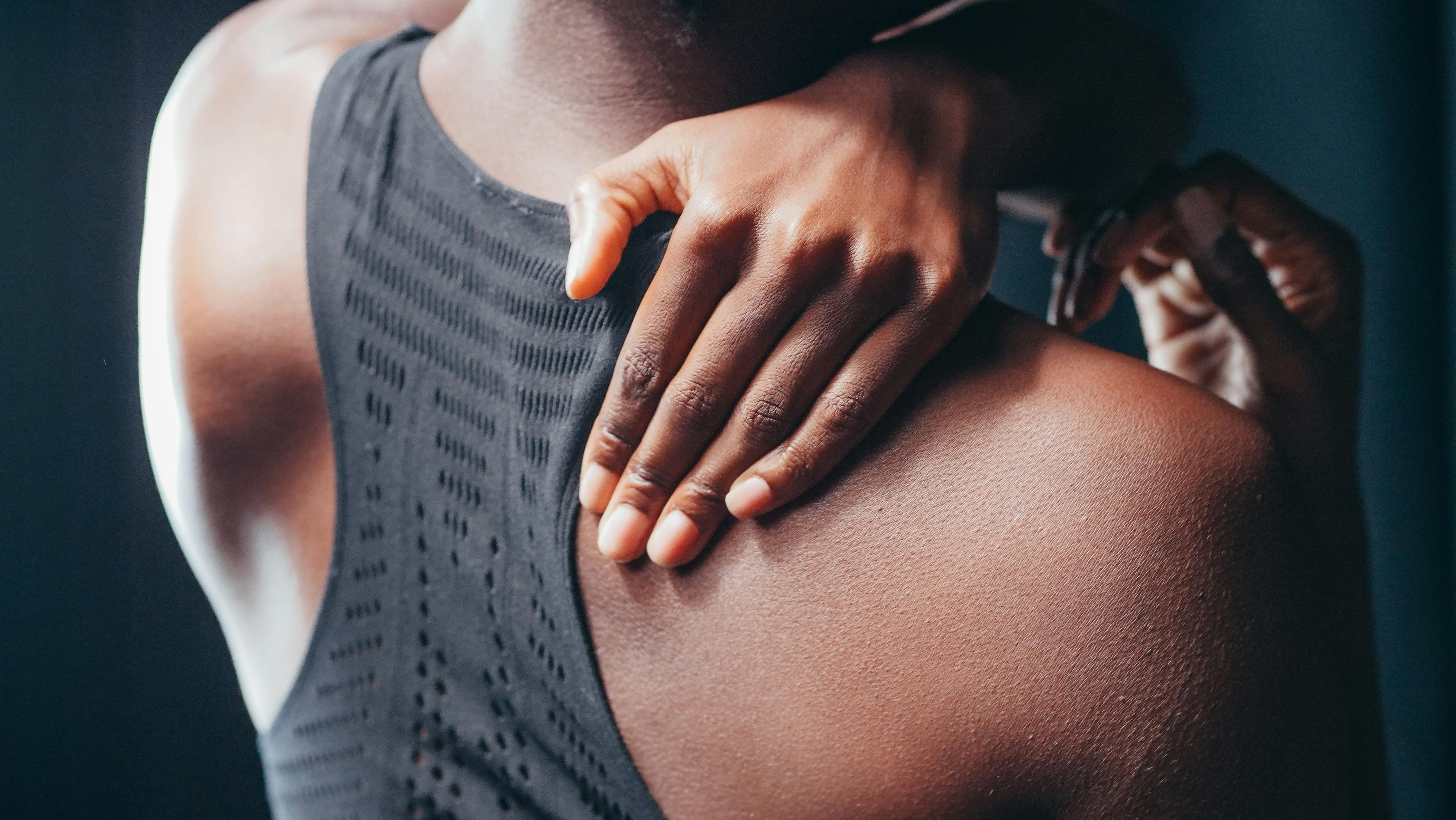
Scapular winging occurs when the medial (inner edge) and inferior (bottom corner) aspects of the scapula (shoulder blade) lift away from the rib cage. This often becomes visible during scapular depression and retraction (pulling the shoulder blade down and towards the spine), but in many cases can also be seen at rest.
Body Mechanics
What is scapulo-humoral rhythm, and why does it matter
Scapulohumeral rhythm describes the coordinated movement between the shoulder blade (scapula) and the upper arm bone (humerus) during arm elevation, such as abduction. After the first ~30 degrees of humeral abduction (think of the early part of a lateral raise), the scapula begins to upwardly rotate in a consistent 2:1 ratio with the humerus — for every 2 degrees the humerus moves, the scapula rotates 1 degree.